
Stay updated with the latest updates from Himalayan Frontiers
Subscribe to our Newsletter Pay Online
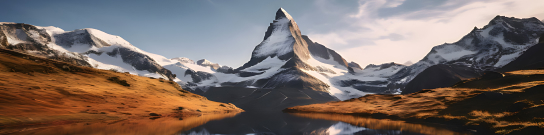
Three passes and four valleys
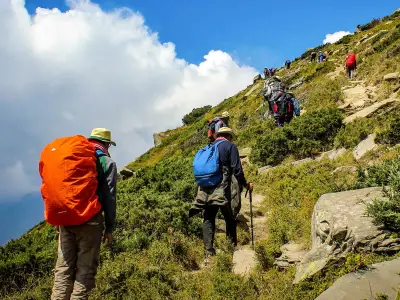
Interection with Nepalis and stunning beauty of Himalaya
Gallery
Duration
Duration

23 days in Nepal, 18 days of trek

Region
Region
  • Everest region: Nepal
Activity
Activity

Trekking

Season
Season

Sep – Dec, Feb – May

Get in Touch with our Trek Expert
Monday - Saturday: 10 Am to 6 Pm (GMT +5:30)
Request a Quote

Description

Renzo la -5360 m, Cho La Dzongla â 4830m, Kongma La -5,535m.

The three passes trek is one of the most popular trek in the world, that attract the adventure enthusiast who intend to get a complete trekking experience of the higher regions of Himalayas.

The trail cross over three passes of Renjo la (5388 m), Cho La (5380 m) and Kongma La (5535 m) and four distinct valleys of Bhotekoshi, Gokyo, Khumbu and Imja tse covering entire Everest region till Everest base under beneath of high mountains peaks.

After exploring Kathmandu, you will take exiting flight providing stunning beauty of Himalaya to Lukla 2800m. To get acclimatize you will take short hikes by spending two nights at Namtche area before long adventurous trek.

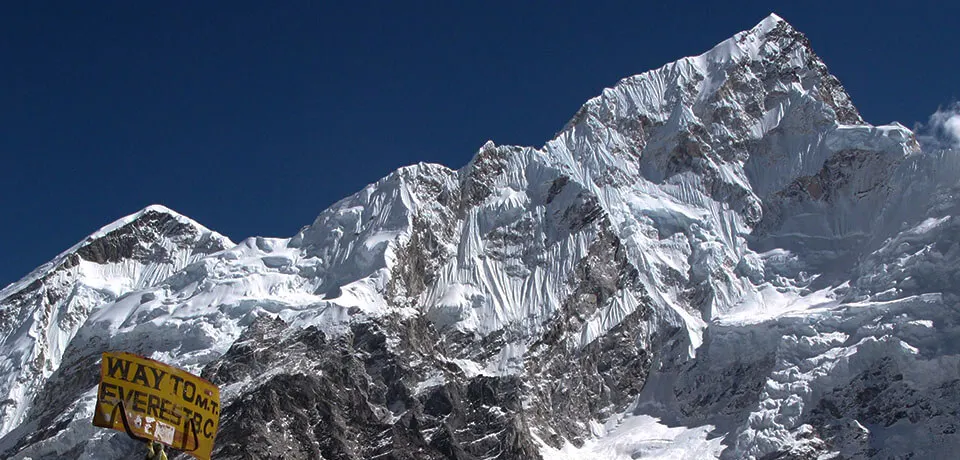
Further trek start following vicinity of Tibet border , crossing 3 passes is tough but is compensate by outstanding views of Everest, Lhotse, Cholatse and Taboche and Gogyo lake, and Cho-Oyu. On the way to hike up to Gogyo ri, when you get glimpse of breathtaking views of sunrise over the Himalayas , trail goes over largest Ngonumpa glacier, cross the Chola pass that leads to the Khumbu valley and further to Kalapathar and to the base camp of the Everest. Enjoy unbelievable Himalayan Panorama, follow up exploring the kalapathar and Everest base camp trek to Chung and crossing the last pass Kongma La that brings you to closer to the Himalayan civilization of the Khumbu Region. En route visit Pangboche monastery. Enjoy stunning view of Amadablam, Lhotse, Nuptse, Makalu and Cho Oyu. Descend to Lukla where ends the strenuous circular trek of 3 passes.


Itinerary

Itinerary

Upon your arrival in the Kathmandu airport (KTM) you will be greeted our representative and Mountain Leader. After completing your custom formalities (Visa, etc), pick up your luggage and look for our representative with a Mountain Leaders who will be waiting for you, displaying board at the arrival gate. You will be transferred to Hotel. After check- in, you can either take a rest or hang around in the city and visit our office; it all depends upon your interests and condition. In the evening, we will organize a "Welcome Dinner" at an excellent traditional Nepalese Restaurant where you will enjoy a Nepalese cultural program as well as a fine meal. Included meal: Dinner (D) Note: B refers to Breakfast, L refers to Lunch and D refers to Dinner

Today after breakfast, we will start a guided tour to some of the most historical and spiritual attractions in Kathmandu. Some of these landmarks are considered World Heritage Sites; including the historic Durbar Square, the sacred Hindu temple of Pashupati Nath, and the famous 'Monkey Temple'. Swayambunath and Buddhists Shrine (Buddha Nath) are among the largest Stupas in the world. In the afternoon, there will be a pre-trip discussion where we can meet our trek leader, other crew and participants of this trek. Mountain Leader briefs us about our trek and further provides the opportunity to ask any questions we may have regarding our upcoming adventure. Included meal: Breakfast (B)

After having early breakfast, we will be escorted to the domestic terminal of Kathmandu Airport for an early morning flight to Lukla (2,800m/9,186ft), a gateway destination from where our trek begins. After an adventurous flight of 40 minutes above the breathtaking green and white mountains, we reach the Tenzing-Hillary Airport at Lukla. This is one of the most beautiful air routes in the world culminating in a dramatic landing on a hillside surrounded by high mountains peaks. Upon arrival at Lukla, we meet our other crew members and after some packing and arrangements, we start our trek through the Prosperous village of Lukla until we reach Phakding. To assist in acclimatization, we only have a short hike today. However, if interested in additional activities, we can take a side trip to a nearby monastery; night in Phakding in a hotel. Included meals: Breakfast, Lunch, Dinner (B,L,D)

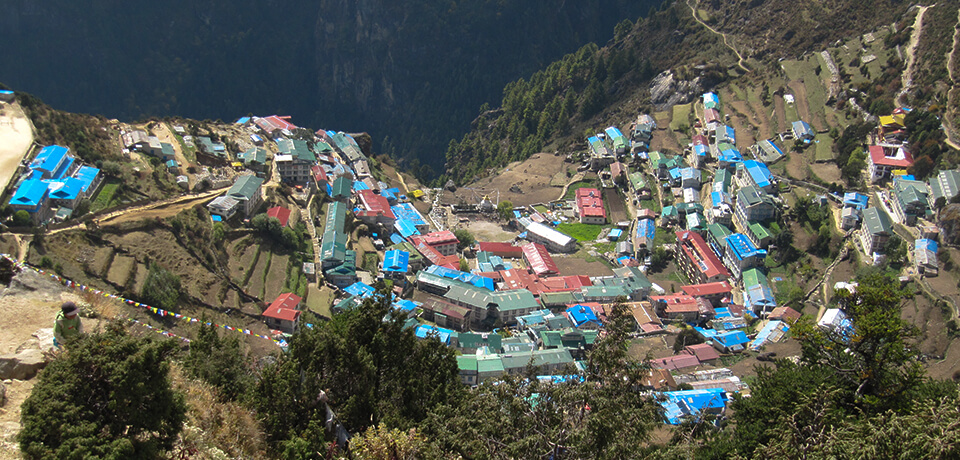
Today’s trek starts in the morning after breakfast. The walk is pleasant with few short uphill and downhill with multiple crossings over Dudh Koshi River and magnificent view of Mt. Thamserku (6,608m/21,675ft) from the Benkar village. We cross more bridges and reach entrance of Sagarmatha National Park at Monjo, where our trekking permits are checked in order to keep record of trekkers and local trekking staffs as well. A descend and a gradual walk brings us to Jorsale, the last village until Namche Bazaar. The walk is enjoyable through the river bed and we reach Hillary Suspension Bridge. Now, as we climb up hill towards Namche Bazzar, closer and magnificent sight of Kwangde Peak, its sister peaks, Kusum Kangaru, Mt. Everest, Lhotse, Tawache, and many other fabulous mountains will be viewed closely. We stop at Chautara to admire the view. Finally, we reach the colorful village of Namche Bazzar, the main gateway of Khumbu region; overnight in Namche Bazzar. (B, L, D).

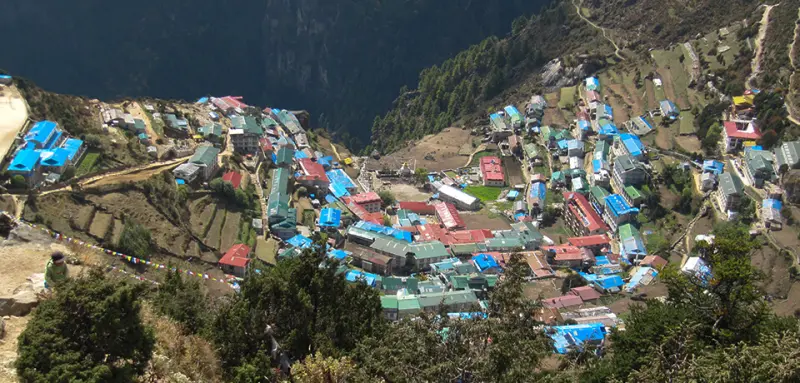
This is the first of the three scheduled "acclimatization" days. Health experts always recommend us to stay active and moving during the rest days instead of being idle. We either spend the day taking a day hike to Thame or visiting Khunde or relaxing and exploring Namche Bazaar itself. If we trek a few hundred vertical feet during the day, it will help us to properly acclimatize. Our guides will take us to the Tourist Visitor Center near the headquarter of the Sagarmatha National Park where we can observe an assortment of things related to the first Everest ascenders, Sherpa culture and learn about the various plant and animal life of the Everest region. Namche Bazzar is the main centre of the Everest (Khumbu) region and has government offices, ATMs, Internet cafes, shops, restaurants, bakeries and a colorful market on each Friday and Saturday evening. If we trek a few hundred vertical feet during the day, it will help us to acclimatize properly; overnight in Namche Bazaar. (B,L,D)

After breakfast, we come out of Namche Bazar, start to the east of the monastery with a short uphill trek. On the left we have the Kongde Ri (6187 m) and the river that flows down into a ravine. On the right is the rocky Khumbi Yul La (5765 m) and behind us is clearly visible on Kusum Kanguru (6,373m). After an hour walking mostly downhill into the forest, the trip continues. At this juncture, the steep rise up about 50m in altitude to reach a ridge around it. The river bed becomes closer and wider. We reach the village of Phorte and then the small town of Samde along the stretch halfway up a slight slope leading to the bridge over the Bhote Koshi (3650 m). Cross it and about half an hour’s climb, we reach Thame. (B,L,D)

If the sky is clear, we will see the beautiful peaks that guard the village from the west. We take our breakfast and head to the next camp towards Marlung. The terrain from Thame to Marlung is alpine zone where vegetation is quite less. We enjoy the peace and relative solitude of this little trekked valley. Next, we turn around the village of Tangmote. After about an hour, we walk parallel to the village of Yellajung on the other side of the Bhote Koshi. We pass by the Tarngga village enjoying superb views of Kongde Ri as we look down the trail. A further 45 minutes or so on a gradually rising trail brings us to Marlung. (B, L ,D)

It is a short walk today from Marlung to Lungden. After Marlung, we walk for about an hour and then climb a small rising hill. After crossing the stream we trek 2-3 hours more to reach Lungdeng. (B, L, D)

The excursion around Lungden (Bhote Koshi Valley) will provide you the views of Everest Himalayan Range, Makalu, Tengi Ragi Tau, Rolwaling Range, and Gyachung Kang. Apart from this, you will experience unique Sherpa Culture along the trail. During the excursion in Lungden you will visit the local village. Hiking up through the nearby hills, you will have a spectacular view of the mountains and topography. Later, hike back to Lungden and have proper rest for tomorrow's trek that will lead us over Renjopass; overnight in Teahouse Lodge.

As we hike further to the top of Renjo La, we get the outstanding views of the surrounding. The Everest itself, Lhotse, Cholatse and Taboche can be seen shining in the sun. Views from Renjo La are similar to Gokyo Ri and Gokyo Lake. Gokyo Village is situated at the foot of the gray smear of Ngozumpa Glacier. We walk further to Gokyo through the glacier. An easy descend brings us to Gokyo. (B,L,D)

Today we rest and acclimatize at Gokyo, exploring the fifth lake. At this juncture, we enjoy the great views of Mt. Everest and Cho-Oyu. If the weather is good, we grasp the opportunity to climb Gokyo Ri today instead of next day to enjoy the scene from the best viewpoint of Everest Region. Moreover, Gokyo is not only popular for its grand view from Gokyo Peak but also for the six lakes which it hosts. Definitely we would not miss the chance to observe the fourth (Thonak Tsho) and fifth lakes (Ngozuma Tsho). If interested, we climb up on the hill at the edge of the Lakes to get astounding views of Cho-Oyu, Gyachung Kang, Everest, Lhotse, Nuptse, and Makulu. Hiking up to Gokyo Ri, rewards breathtaking views of sunrise over the Himalayas. After exploring the Gokyo Ri area, we get back to the camp for rest. We enjoy the feeling of being surrounded by panoramic mountains like Kusum Kanguru, Thamserku, K 43, Kangtega, Taboche, Cholatse, Makalu, Lhotse, Nuptse, Everest, Changtse, and Pumori. (B,L,D)

Today, we are on the trail to Thaknak. Sometimes Thaknak is pronounced as Dragnag. We climb out of the Gokyo village to a ridge. Then, we take the route through the Ngozumpa Glacier to the mountain on the other side. Continuing further and traversing along the edge of that mountain, we descend down to Thaknak. On the trek, we enjoy the magnifiscent views of Cho Oyu, Gokyo Ri, and other high Himalayas. (B,L,D)

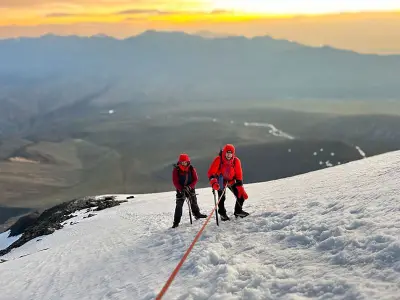
Today, we trek to the Cho La Pass. Cho La pass is also another show up of this trip. Today is going to be one of the toughest days. The pass is not itself difficult but it is steep and involves a glacier traverse on the eastern side. We need to be careful as the trail is vertical and the rocks glazed by ice add trouble to the trekkers making the trail slippery. Our trail climbs through a ravine and a rocky trail. So, we climb up continuously up from Phedi. We trek through the side of a frozen lake and reach the top of the pass decorated with prayer flags. We need to pass through some crevasses before we reach Dzongla, another beautiful place with a complete view of Mt. Cholatse, Mt. Ama Dablam, Lobuche peak and the Pheriche village far below. (B, L, D)

Today, we head towards Lobuche by descending down from Dzongla. After crossing a bridge, we traverse through grassy trail. Enjoying the view of Lobuche Peak, we stretch up eventually through a ridge. The mountains of Ama Dablam, Kangtega, Thamserku Taboche are seen looming prominently. Curving round through the wide gravelly river bed, we reach Lobuche. (B, L, D)

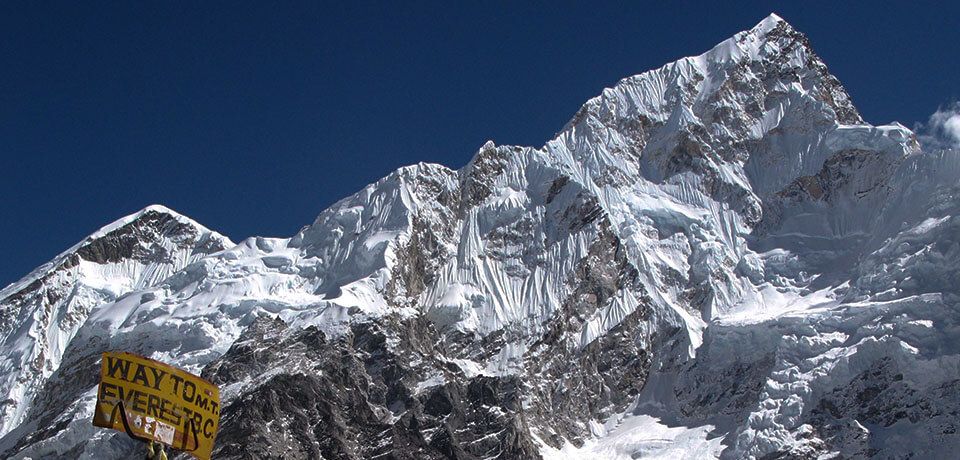
The trail to Gorak Shep goes ahead through the lateral moraine of the Khumbu Glacier. We pass through the pyramid sign post. Ahead on the trail, we see crest of north ridge of Everest along with Mt.Pumori, Mt. Mahalangur, Mt. Lingtern, Mt. Khumbutse, Mt. Nuptse, etc. A small ascent would take us to Thangma Riju from where we perceive 360 degree vista of snowy mountains. Climbing steeply up to the top through the torrent of Changri Glacier, we catch our first glimpse of Kala Patthar, a grey- green knoll beneath the Mt. Pumori. As we reach Gorak Shep, we will find snow-capped mountains looming all around us including the top of the world - Mt. Everest. After a short lunch and rest, we take the trail to Everest Base Camp through the once vast Gorak Shep Lake. Continuing straight ahead, we come through the Indian army mountaineers memorials.Only upon reaching the Everest Base Camp, we really appreciate the Everest climbers who brave the hazardous route through the Khumbu icefall. Mountaineer's tents stand out in bright colors against the monotony of gray surroundings (especially in the Spring). Nuptse, Khumbuste and Pumori are the mountains we can view from the base camp. Everest actually is not visible from here. By now, we have met the ultimate objective of our trip. Or in case time is not enough in hand, climbing to Kalapathar and Everest base camp tr can be done next morning as it takes more time than Klapathar.

We start early in the morning to catch the dramatic views from Kala Patthar witnessing the first light of day shining on Mt. Everest. However, we need to get prepared for an early morning, dark and cold temperature (-10 to -14 C) departure beforehand. Further, there is always the potential of chilly winds which are quite common. Familiar peaks such as Lingtren, Khumbutse, Changtse tower to the east even as Everest begins to reveal itself emerging between the west shoulder crest and Nuptse. During the ascent to Kala Patthar we can pause to catch our breath at several outstanding view points to snap pictures. After several hours of ascent, we will be at Kala Patthar. From this juncture, we scramble to climb the rocky outcrop near to the summit marked by cairns and prayer flags. As we reach the top, we sit on the Kala Patthar where our eyes stuck to take the unbelievable Himalayan Panorama, wandering from one mighty massif to another. We take as many pictures as we can and take the view in our mind for lifetime to cherish. On being back to Gorak Shep, you will take breakfast. If you had done this hike day before, you will trek to Everest base camp and will reach by lunch time as Everest base camp hike takes longer time (4 - 5 hrs) than the Kala Patthar hike. Upon return back to Gorak Shep, take lunch and afternoon time is taken to descend down to Lobuche for a good night's rest. (B, L, D)

From Lobuche, we pass through Khumbu Glacier. On climbing up, we reach Kongma La. Here, we will find a Pyramid shaped Italian Research Centre at just over 5,000m. We enjoy the views of the wide basin dotted with frozen lakes. Again we enjoy the marvellous views of Cholatse, Pokalde, Nuptse, Lhotse, Makalu and Ama Dablam. Then we turn and walk through the stony trail. While descending down the Niyang Khola valley, we enjoy the great views of Amphu Lapcha Pass and Island Peak. Trekking further, we get to Chukkung. (B, L, D).

Chhukung is also the starting point for the Island Peak Climbing. Now we are getting closer to the Himalayan civilization of the Khumbu Region. The Imja Khola joins the Dudh Koshi River a little above the Pangboche Village. There is a famous monastery at Pangboche believed to have been the oldest in the Khumbu region. From Pangboche, we descend down the alpine desert and back to greenery of pine forests. The path leads to a steep uphill climb into Tengboche. We pay our visit to the famous Tengboche Monastery. (B, L, D)

From Tenboche, we make a steep descent and the trail leads us back along the Dudh Kosi River. We keep a lookout for wild life such as mountain goats, snow leopards, colorful pheasants, etc., while passing through the forest by the trail. After passing a Chorten, we reach the army camp at of Namche Bazaar. Here we would like to take a long last look back to Lhotse, the tip of Everest and Tengboche. The final steep descend, traversing the hill side takes us to Namche Bazaar. We take a nice hot shower and have very relaxed sleep in our room in Namche Bazaar. (B, L, D)

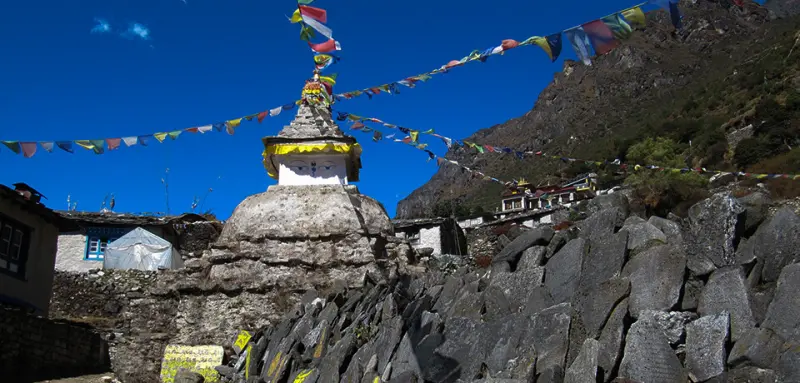
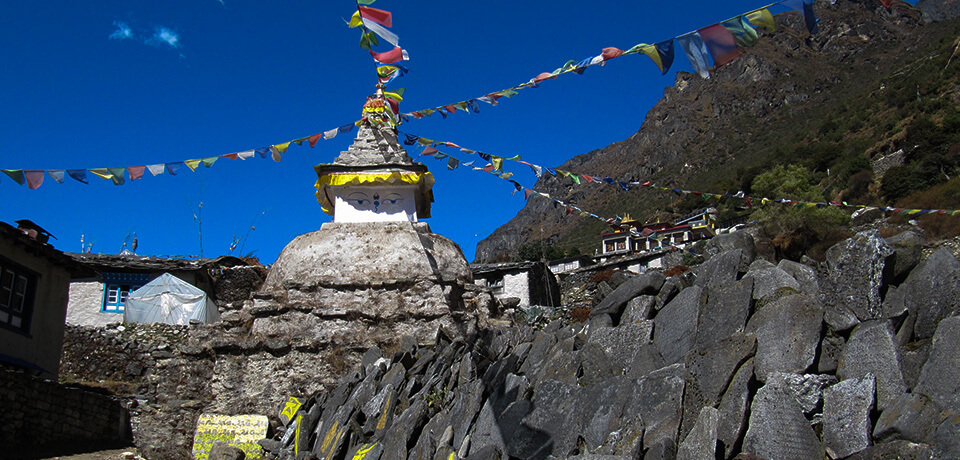
The trail descends steeply downward so we need to walk slowly and under control as our shaky legs continuously battle the rocky terrain. After crossing the suspension bridges over the fast flowing Dudh Koshi and its tributaries, the trail becomes more level and natural. By today, we start to get warmed up by the light breeze. Any remaining sore throats and colds will be gone by today as we pass through this charming mountain air. Although we are travelling the same route down, we feel completely different views. We snap a combined view of open plains, rhododendron, pine forests and distant snow covered peaks. We walk through the Sherpa villages' noticing impressive faith in Buddhism and culture of prayer stones and prayers flag. Upon arriving Lukla, we stretch our sored legs and recall the memories of the last couple of weeks. We experience the culmination of a fantastic trek on a happy note with everyone back safe and sound with smile on faces! Overnight at Lukla (B, L, D)

We fly back to Kathmandu after our long mountain journey. The early morning flight drops us at Kathmandu. We can rest and relax throughout the day at our hotel. If we get interested to take some gifts to home from Nepal, we can visit some nearby shops or venture out in Thamel for typical Nepalese goods. You can be assisted by Mountain Leader's guides or you can do it yourself.

For Inquiry

Cost

Dates Availability Price
No fixed departure dates available yet.

Dates don't fit?

Create a Private Trip
If you have your own group, talk to us about turning this itinerary into your own private adventure.

What's Inside the Package?


Inclusions

checkAirport pick up & drop by private vehicle

check3* Hotel in Kathmandu breakfast included

checkKathmandu City Tours by professional tour guide and private vehicle

checkAll your standard Meals (breakfast, lunch and dinner) during the trek

checkTea Houses/Lodges, Guesthouses accommodation during the trek

checkEnglish speaking guide

checkPorter to carry your luggage during the trek

checkFood, accommodation, salary, insurance, equipment’s, medicine for all trekking staff

checkNational Park permits

checkTIMS Card

checkGovernment Tax Domestic air tickets KTM (Ramechhap-)-LUKLA-KTM (Ramechhap-)

checkDomestic flight Fare of Guide (Kathmandu-Lukla-Kathmandu)

checkWelcome Dinner

Exclusions

closeLunch and dinner whilst in Kathmandu

closeYour travel insurance (compulsory)

closeInternational airfare and airport departure tax. Visa

closeItems of a personal nature such as alcoholic drinks, cold drinks, laundry

closePersonal trekking Equipment

closeTips for trekking staff and driver

closeEmergency Rescue Charge

closeMonument visiting fee Euro 25 per person

closeAny others expenses which are not mentioned on Price Includes section

Highlights

  • Charm of Kathmandu city
  • Exciting mountain flight
  • Stunning close view of numerous Himalayan giant peaks.
  • High altitude civilization of isolated villages
  • Charm of Kalpathar and Everest base camp
  • Alpine zone and glacier fields
  • Turquoise lakes of Himalaya.
  • Interaction with Sherpa’s and other ethic people.

General Information

Calculate Your BMI
Your BMI value is
--
Calculate your BMI
BMI RangeCategory
Less than 16.5Severely Underweight
16.5 - 18.5Underweight
18.5 - 25Normal
25 - 30Overweight

Join The Newsletter

To receive our best monthly deals